Why Does Los Angeles Choose to Be Unaffordable?
ED1 shows that affordability is a question of people versus parking

W4Ev member Jonny Hale. Follow his Substack for more writings here.
One May day I was walking my dog through my lovely neighborhood of Sawtelle when I stumbled across a film crew set up outside an apartment under construction at 1734 S Barrington Ave. The project was being built under Executive Directive 1 (ED1), a directive passed by Karen Bass that allows affordable housing an exemption from parking mandates.
I knew this because I’d advocated for this building and its counterpart a block over at 1747 Stoner at an extremely contentious Neighborhood Council meeting last year. I figured the crew were doing some sort of promotion for ED1 and the homes it was building. So I stuck around and sure enough, Mayor Bass arrived on scene.
ED1 is an awesome law because it illustrates the fact that the housing shortage is a deliberate choice. It also shows how cars and car dependency make housing more expensive. And it lays bare the resistance of neighbors to allowing working people to live in their neighborhoods if it means that they will share the same public street parking spaces.
I shook the Mayor’s hand, mentioned my connection to the neighborhood, and thanked her for passing ED1 — even though she had quickly backtracked and severely restricted where ED1 could apply after landowners complained. A couple weeks later, I received a mailer featuring Karen Bass standing with a group of people in front of the 1734 Barrington project. The day this was shot, I was standing behind the camera with my dog watching the whole thing play out. The irony.
Flash back to a year ago, May 20th 2025. The West LA Sawtelle Neighborhood Council was hosting a “listening session” on ED1 projects in Sawtelle, including the apartments at 1734 S Barrington, 1747 Stoner, and others. People were furious that affordable housing without parking was being built near them.
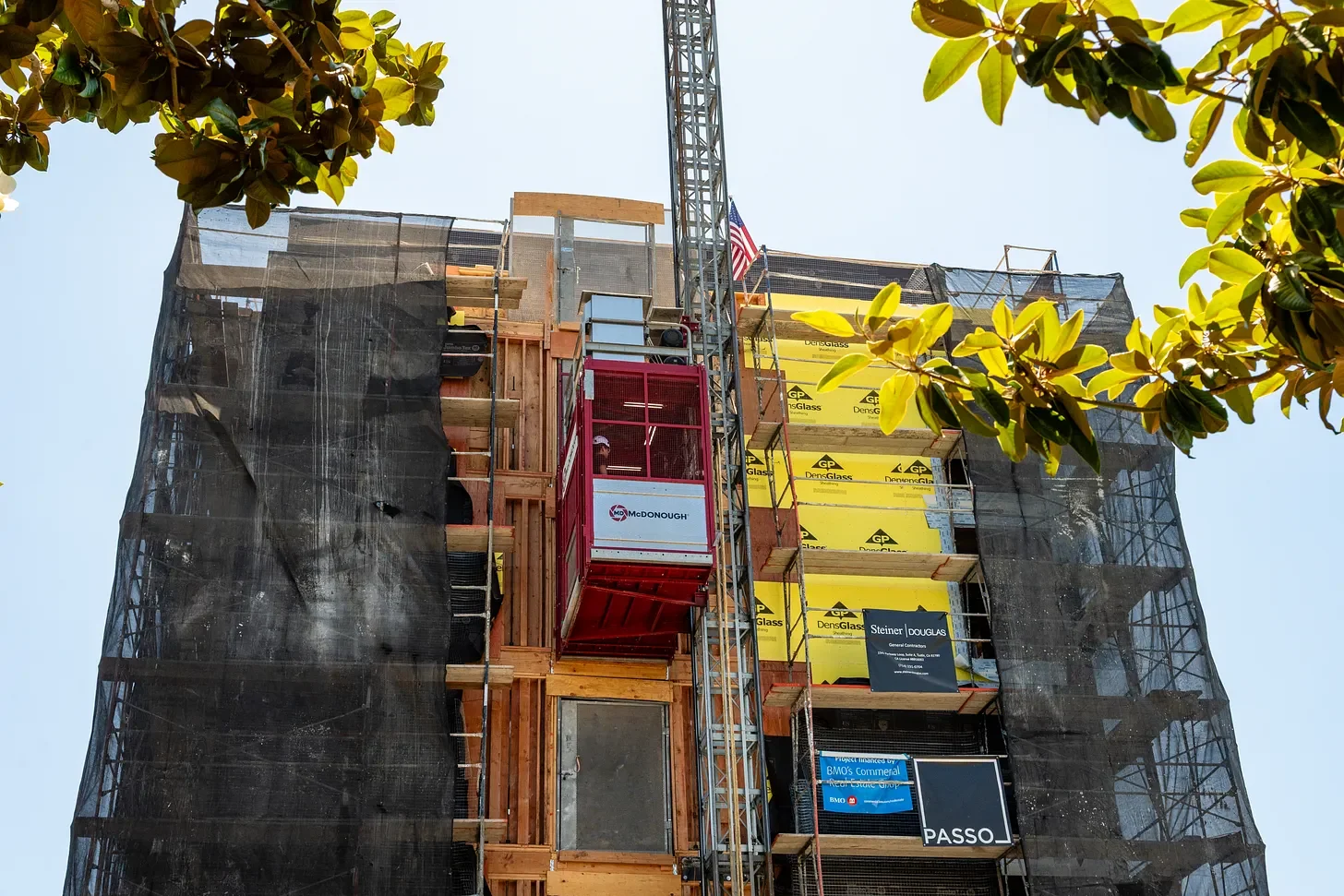
Affordable homes going up at 1747 Stoner. A disaster for land speculators.
One woman described her disdain for construction workers: “They’re up at 7, they leave at 3 but the music goes on, they’re yelling at each other, they’re hanging around like monkeys” (19:19). Other landowners demanded compensation for any lost property value from having affordable housing built near them. “This is essentially a Palisades fire happening to me,” said a landowner, expressing that the construction of affordable housing would affect the value of one of her properties located nearby (34:23).
I wish I was joking, but these are real things that people said in opposition to affordable housing in Los Angeles. The vehement opposition to affordable housing caught me off guard at that meeting a year ago. I was still pretty green to the housing space and stumbled through a public comment in support of the proposed projects.
To be charitable let’s assume this all comes down to parking. I think there’s probably more people than we’d like to admit who don’t want affordable housing near them because they’re legitimately worried about poor people living near them. And there’s of course the landlords and homeowners concerned with property values. But let’s set aside the thinly veiled racism and classism and talk about why affordable housing and parking are interlinked.
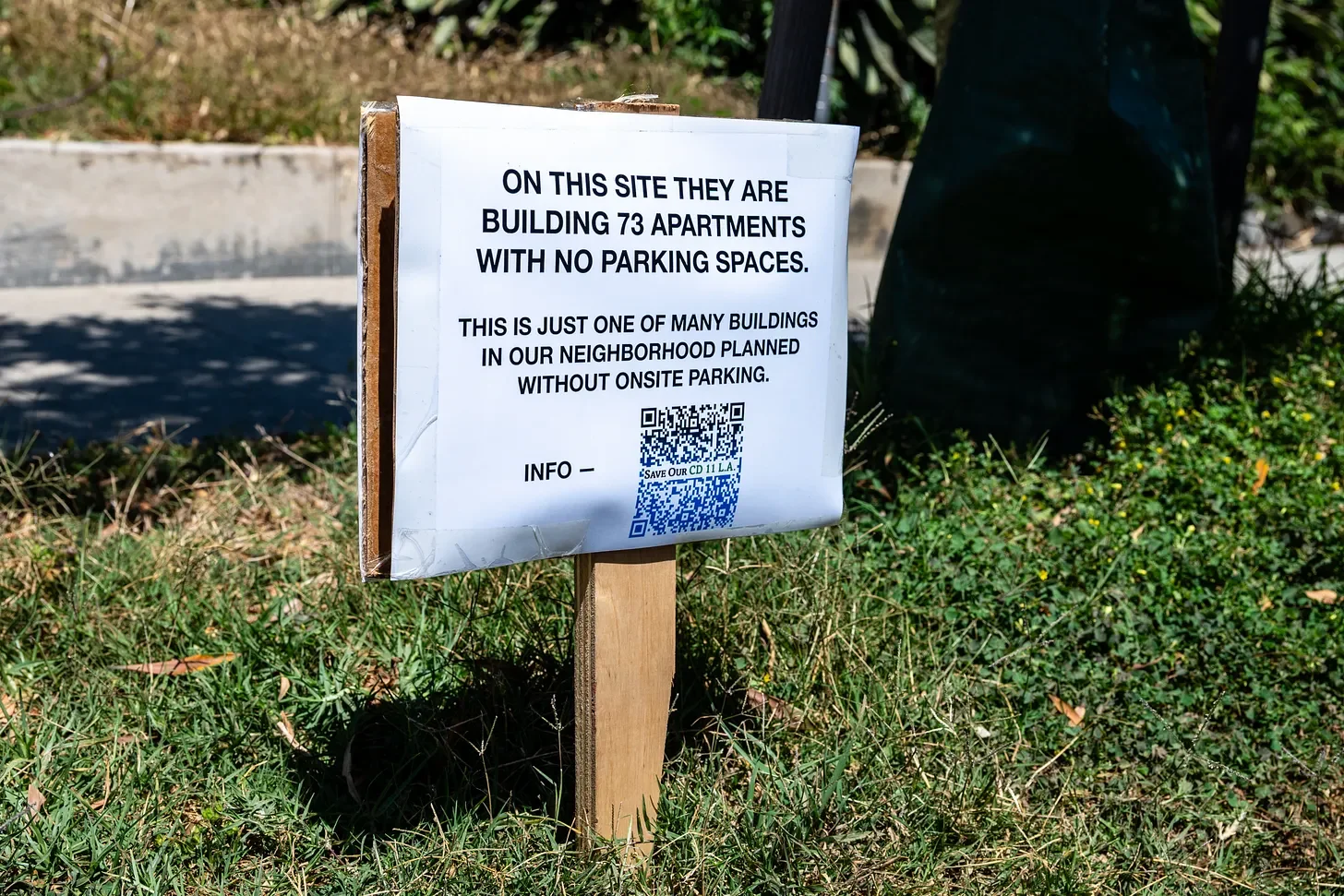
If you’re wondering why LA is unaffordable, it’s because of the type of people who have the time at their disposal to put these signs up.
Parking is never free
ED1 works because parking is expensive to build, costing as much as $100,00 per space. This is because to make space to store all those empty cars, you have to dig a big pit underground or a multi-level parking structure. The latter is less expensive but leads to a streetscape dominated by dead space and parking garage entrances, and can add several stories of height to a building. Building homes for the cars before building homes for people also takes time, and time is money. If parking is mandated, the housing will necessarily be more expensive.
Well why doesn’t the government just build affordable housing? The city of Los Angeles is broke, so we can’t afford the subsidize the affordable housing we need to solve the current shortage. ED1 is so effective because it makes it possible for private builders to build affordable housing without government subsidy. It’s the best tool we have in our toolkit to actually lower the cost of rent.
If you’re wondering why LA is unaffordable, it’s because of the type of people who have the time at their disposal to put these signs up.
In The High Cost of Free Parking, urban planner Donald Shoup uses an analogy to explain why parking mandates make everything more expensive. Imagine there was a law that required restaurants to start serving dessert with dinner. When you ordered dinner, you’d get a “free” dessert. But it wouldn’t really be free: restaurants would just raise the cost of dinner to cover the dessert they were required to provide.
Some people would end up eating dessert they didn’t really want, just because it was there and why not? For the people that weren’t hungry, a lot of food would go to waste. And higher prices would make it harder for most people to afford the cost of eating out.
Requiring builders to add parking to an apartment is like requiring restaurants to serve dessert with dinner. When we mandate parking, we impose costs on housing that get passed down to renters. Parking mandates mean that people will be paying for the cost of parking regardless of whether they own a car. So why not drive then? There’s no incentive to reduce one’s car usage or take public transit. The people that can’t afford a car to begin with are stuck paying for parking all the same while the land used to store the cars they don’t have sits empty.
Parking mandates make housing more expensive and keep Los Angeles trapped in car dependency. If you can’t afford a car, you end up paying for one through the higher cost of living in a building subject to parking mandates.
It seems especially nonsensical to oppose affordable housing because it has no parking in a neighborhood as dense and walkable as Sawtelle. This is a neighborhood with close proximity to the future D line station at the VA complex and the E line stops at Expo/Sepulveda and Expo/Bundy. There is fast and convenient local bus access to UCLA, Santa Monica, Venice, and West Hollywood.
Many young professionals and veterans live here, and the two locations where these people travel — the VA and UCLA — are both easily accessible through micromobility and public transit. Sure, some people may choose to drive, but why force them to do so by mandating parking? If there’s any neighborhood where it makes the most sense to build affordable housing that doesn’t require parking, it’s Sawtelle.
That’s another thing: many of the ED1 projects in this neighborhood are being built specifically for low-income veterans. Many of the people living in their vehicles or on the streets in Sawtelle are veterans who need to be close to the VA, where they get services, but can’t afford the cost of living on the Westside. That’s the case with the 1734 S Barrington project, as well as the 11418 Missouri project, another project people complained about at that May 20th meeting last year that has since been completed and rented out.
Some builders may choose to add parking because they feel it will make their building a more attractive and convenient place to live for the consumers they are hoping to attract. And that’s fine, that’s their choice and nobody’s stopping them. Those units will probably be more expensive than others that don’t have parking. It’s mandating the parking that makes housing more expensive for everybody.
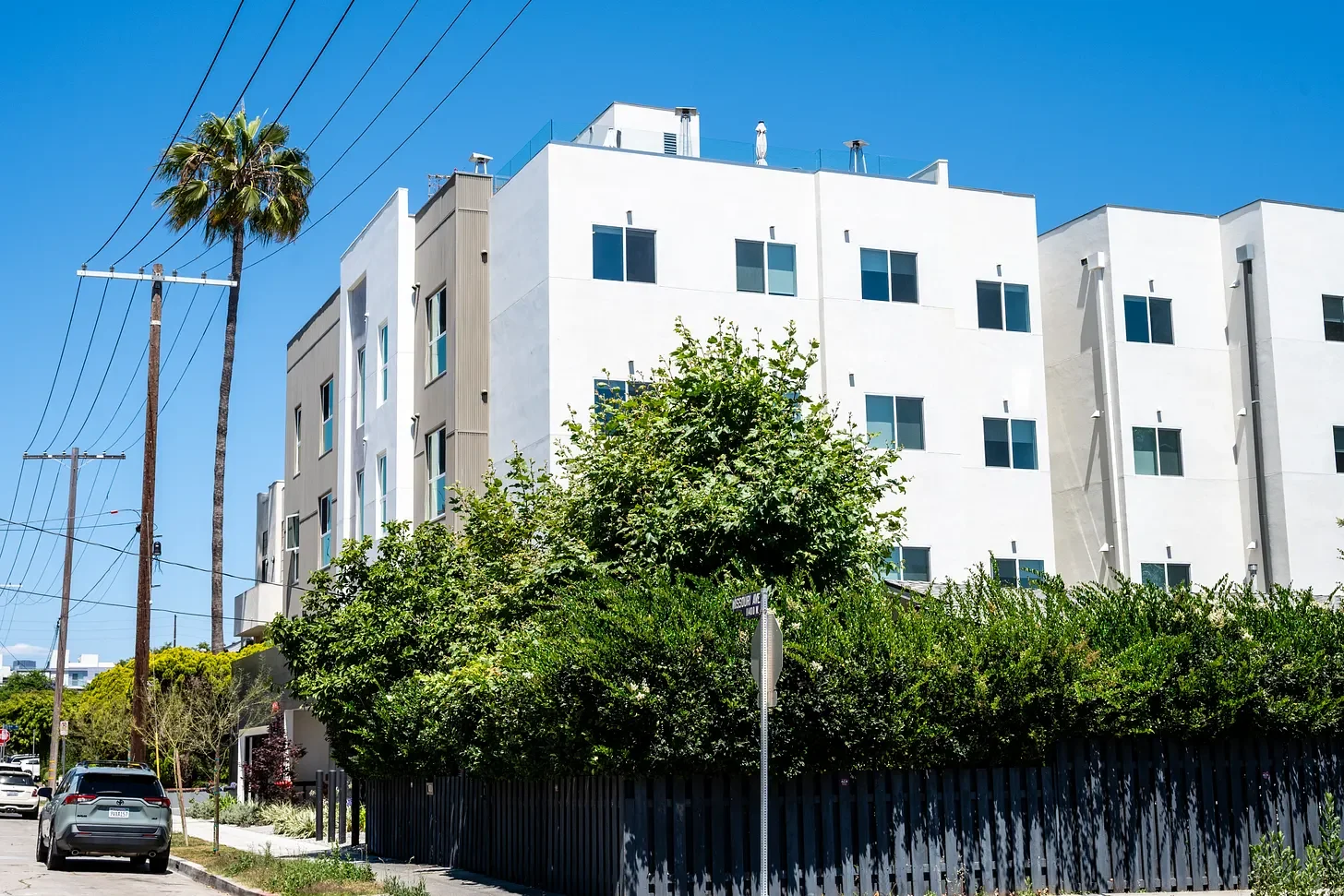
Affordable homes for veterans at 11418 Missouri, made possible through ED1 and built despite NIMBY objections.
Planning for the public good
The point is that ED1 proves it’s entirely possible to build abundant, affordable housing at scale without costing taxpayers a dime. The fact that Los Angeles is so unaffordable, that over a quarter of renters are paying more than half their income in rent, that homelessness is so rampant — these things are all optional.
No single landlord complaining about parking at a neighborhood council meeting got us to where we’re at, but rather a series of opaque regulations, public comments, lawsuit threats, and bureaucracy. Decision making power has shifted from smoke-filled backrooms to obscure committee meetings on weekdays that extend hours into the night, where NIMBYs air grievances and obstruct barriers to new housing.
To landowners the idea of people struggling to pay rent isn’t the emergency. Rather, the true emergency is that they will have to share city-owned public street parking spots with working-class people living in apartments. And they’ll go so far as to speak on behalf of those working-class people to say that they wouldn’t want the apartments anyway because of the lack of parking!
ED1 also shows how parking is not a public good. Examples of public goods include things like street lights, sidewalks, and clean air. A public good is non-excludable, which means you can’t stop people from using it once it’s provided. A public good is also non-rival, meaning one person’s use doesn’t diminish availability for others. Imagine if local landlords were fighting affordable housing because it would mean that there would be more people walking on well-lit sidewalks, breathing smog-free air! Our car dependency divides us and places us in competition for limited space that we use to store our empty vehicles. If parking isn’t a public good, then why do we plan our society around it as if it were?
So yeah, there you have it. Los Angeles does not need to be unaffordable. ED1 presents communities with a clear choice. Do we want to build affordable housing, fast… or do we want to impose parking mandates that keep Los Angeles car-dependent and over-priced? Landlords and homeowners are fighting tooth-and-nail for the latter outcome. But that’s not the way things have to be.